
What Is a 12-Digit Calculator? Key Differences From an 8- Digit Calculator.
A 12-digit calculator is a business-grade calculator designed to display and process up to twelve digits, making it ideal for accounting, finance, retail operations, and any task requiring accurate large-number calculations.
This guide compares 12-digit calculators with 8-digit models, explains why digit capacity matters, and helps you determine which one is right for your needs.
Table of Contents
What Is a 12-Digit Calculator?
A 12-digit calculator can display and compute up to twelve numerical digits, allowing accurate handling of large values, high-precision decimals, and multi-step financial operations. It is commonly used by accountants, office workers, and business professionals.
1. Understanding Digit Capacity: 12-Digit vs 8-Digit
Digit count refers to the maximum number of numeric characters a calculator can show on its display at one time—including whole numbers and decimal places.

1.1 What a 12-Digit Calculator Can Do
A 12-digit screen can show values up to:
999,999,999,999 (almost one trillion)
Advantages:
- Handles large totals without switching to scientific notation
- Maintains decimal accuracy
- Avoids rounding errors common in simple calculators
- Suitable for tax, markup, interest, and multi-step formulas
Typical users:
- Accountants
- Corporate finance professionals
- Real estate agents
- E-commerce sellers
- Retail and POS operators
1.2 Limitations of an 8-Digit Calculator
8-digit calculators top out at:
99,999,999
Limitations:
- Automatically converts to scientific notation for large results
- Can round decimals aggressively
- Less suitable for business calculations
Typical users:
- Students
- Home budgeting
- Grocery/household math
2. Why 12 Digits Matter in Business & Finance
2.1 Large Numbers and Financial Formulas Require High Capacity
Real-world calculations often exceed 8 digits:
Example:
500,000,000 × 15% = 75,000,000
→ A 9-digit answer that an 8-digit calculator cannot show precisely.
12-digit models handle:
- Compounding interest
- Cost and tax calculations
- Profit margins (MU keys)
- Inventory totals
- Multi-step accounting processes
2.2 Avoiding Rounding Errors
Small rounding errors can accumulate into:
- Incorrect financial statements
- Tax calculation discrepancies
- Variances in accounting reports
A 12-digit calculator preserves:
- Decimal precision
- Intermediate values
- Full output without truncation
This aligns with accuracy principles described in digital calculator definitions from Wikipedia:
3. Feature Comparison: 12-Digit vs 8-Digit

4. Beyond Digit Count: Other Important Features
Professional-grade 12-digit calculators often include:
✔ Key Rollover
Allows fast input without missed numbers.
✔ GT (Grand Total) Function
Automatically sums previous calculations.
(See your upcoming GT Key article.)
✔ MU (Mark Up) / Profit Margin Keys
Quickly calculates selling price and margin.
✔ Tax Keys (TAX+ / TAX–)
Ideal for global/e-commerce sellers who deal with VAT or sales tax.
✔ Decimal Selector
Fix the output at 0, 2, or more decimal places.
These features make 12-digit calculators dominant in business environments.
5. Real-World Example: Accuracy Difference
Try this:
(A) On an 8-digit calculator
Enter: 999,999,999 × 8.75%
→ Result will show scientific notation or round off digits.
(B) On a 12-digit calculator
Shows full output clearly:
874,999,999.125
This difference directly impacts:
- Tax reporting
- Profit calculations
- Inventory valuation
- Multi-step financial audits
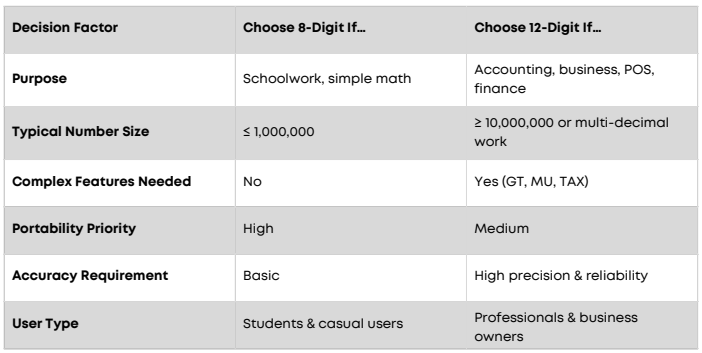
6. Choosing the Right Calculator (Decision Matrix)
7. Which One Should You Buy?
Choose a 12-digit calculator if you:
✔ Work in finance, retail, e-commerce, or office administration
✔ Need to calculate large totals or precise decimals
✔ Want a calculator that will not round or truncate values
✔ Require GT, MU, or tax functions
Choose an 8-digit calculator if you:
✔ Only do simple household/student math
✔ Want a compact, budget-friendly model
8. FAQ
1. What is a 12-digit calculator used for?
Used for accounting, tax calculations, inventory totals, and large-number operations.
2. Does a 12-digit calculator give more accurate results?
Yes—fewer rounding errors, full decimal precision, and clearer outputs.
3. Why does my 8-digit calculator show scientific notation?
Because the number exceeds its 8-digit capacity.
4. Are 12-digit calculators better for business?
Absolutely. They are the standard in offices and financial environments.
5. What’s the main difference between 12 digits and 8 digits?
12-digit models handle larger values and high-precision decimals, while 8-digit calculators are for simple tasks.
Conclusion: Why Digit Capacity Matters
A 12-digit calculator is essential for professionals who handle large numbers, high-precision decimals, or multi-step financial operations. It offers accurate results, prevents rounding errors, and supports advanced functions like GT, MU, and TAX—making it ideal for accounting, retail, finance, and e-commerce work.
An 8-digit calculator is suitable for simple math and everyday tasks but cannot reliably support business-level calculations.
Choosing the correct digit capacity ensures accuracy, efficiency, and long-term productivity in any workflow.
Ready to Upgrade Your Calculator?
👉 Explore our recommended 12-digit calculators here:
🛒 Shop Now: